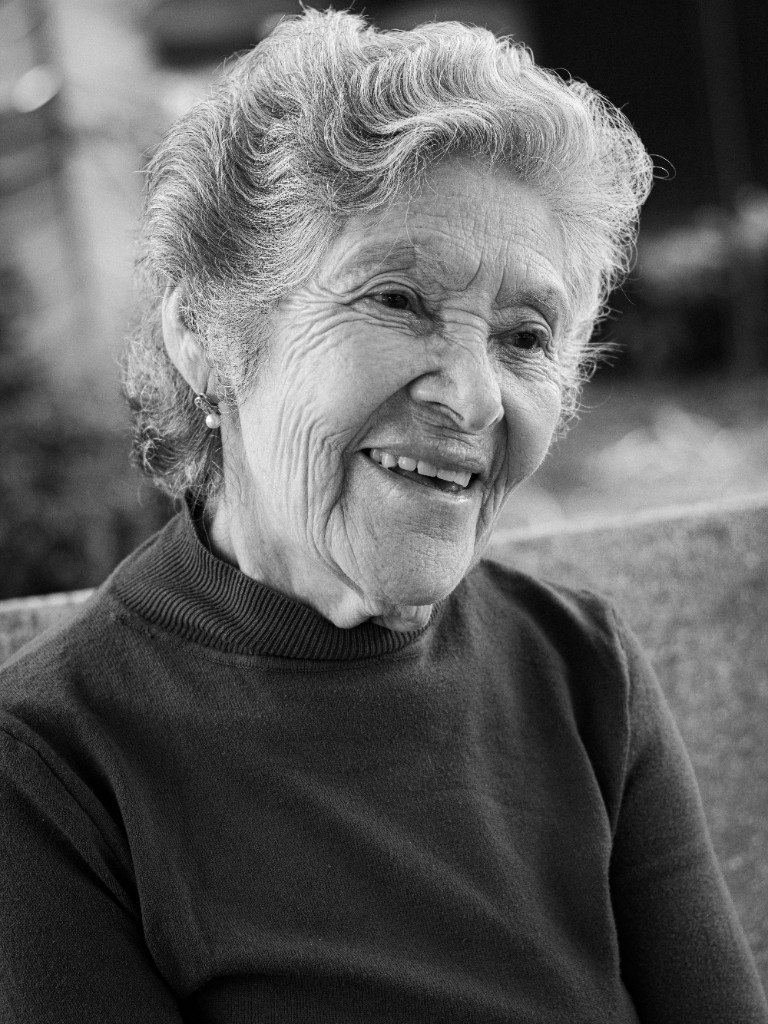
One day you won’t be able to ask for these stories to be told
A Lifetime Together
Ona Kazlauskienė
Read your digital book
1
Contents
2
A Place Called Home
It was not a big house by any stretch — just a modest wooden place that needed painting more often than my father had time for. But to me it felt sturdy and safe, as if it had always held us together.
A lifetime together
3
The walls cracked softly in the winter cold, and in spring the scent of wet earth came back through the open window. Every season changed the house, yet to us it always stayed the same.
The living room was the first thing you saw when you walked in. There was a worn sofa and a table that always held a stack of letters, newspapers and old photographs. Through the window we saw a garden where every tree had its own story.
A cabinet with glass doors stood in the corner. It held the better cups, a few books and a box of letters that children were not allowed to touch. Before every celebration mother took out the dishes and wiped away the dust, and the room changed at once.
In the evenings the house grew quiet, but it never felt empty. You could hear the clock, the crackle of the stove and soft voices in the kitchen. The kitchen was the true centre of the house: there we did homework, mended broken things and waited for the last of the family to come in from the yard.
In winter the kitchen windows flowered with frost. In the mornings we drew small circles in it with a finger to see whether the road had been cleared. Water warmed on the stove while mother made breakfast for each of us at a different time. Even now, when I remember that room, I first hear teaspoons against cups and the creak of the door.
Behind the house a narrow path led to the vegetable garden. In summer it smelled of blackcurrant leaves, and in autumn it lay
4
Father with us by the fence
under the leaves of the apple tree. Father kept an old bench by the fence and sat there at the end of the day. Sometimes we stayed silent together, listening to the starlings and a distant train.
I did not yet understand that such ordinary hours stay with us the longest. Today I could cross the whole yard with my eyes closed and remember every uneven stone. Years later, making a home of my own, I repeated the same small gestures without noticing: I straightened the tablecloth, switched on a lamp and left the kitchen door slightly open.
5
The Long Summers
Childhood days
Summer began with bare feet on wet grass. Until evening we built hiding places in the yard, picked apples and listened to the dishes clatter in the kitchen.
We had our own paths across the fields and secret places beside the stream. It seemed the adults knew nothing of them, though now I suspect they always knew exactly where we had gone.
By noon the meadows grew so warm that even the grasshoppers fell silent for a while. We lay beneath the old pear tree and watched the clouds, finding ships, animals and distant cities in
6
them. Our pockets always held string, a folding knife and a few sweets, because any outing might turn into a real expedition.
We came home dusty, with scratched knees and enormous stories. Mother listened with a serious face, though her eyes told us she had known about our greatest adventures for a long time. She left the door open and put a jug of water on the table.
The little gardener
As dusk came, cool air rose from the fields and at last we wanted our jumpers. We still did not hurry home: the game had to be finished, our treasures hidden and the morning meeting place agreed. At the gate I heard mother call my name and knew that supper was waiting.
7
In the evening we sat on the steps, counted the first stars and decided what tomorrow would bring. Our plans were grand, even though we usually returned to the same trees and the same stream.
Only now do I understand how much of those summers stayed with me — the scents, the voices, the light through the old window and the feeling that the whole world was within reach by bicycle. Those evenings taught me that safety can be as simple as a familiar voice reaching you across a darkening yard.
8
Around One Table
On Sundays we all sat down together. Everyone brought news, grandmother kept urging us to take another helping, the children laughed, and nobody hurried away.
Bread, butter and grandmother’s jam always appeared on the table, even when lunch was long over. She said people talk best when they are not hungry. So over the years neighbours, relatives and unexpected visitors came to sit with us too.
Together in the kitchen
Grandmother had embroidered the tablecloth herself, and the dishes came from several different sets. Nothing matched, yet the whole table felt unmistakably ours.
9
The family stories came a little at a time, often familiar, but always with one new detail. One person remembered a name, another the weather or the song playing that evening. I especially waited for someone to say, “Do you remember?” Then the talk would pause, and every face turned to the storyteller.
Grandmother knew how to tell a story without hurrying. She paused to find a more exact word, and we waited, because the most important part came after the pause. In her stories people were never simply good or bad — they made mistakes, put them right and laughed at themselves.
After the guests left, we cleaned the kitchen for a long while. That was when I heard the quietest stories — the ones not meant for the whole table, which later became the most precious.
Now I understand that around that table we learned more than how to listen. We learned to remember one another.
10
Mother and the little one
11
My First Real Job
On my first day I arrived almost an hour early. I wanted to look calm, though in my pocket I held a note with the bus time and the name of the person I was to ask for.
The workshop smelled of wood, oil and strong coffee. The older workers said little, but they watched to see whether I could listen and whether I was willing to begin with the simplest jobs.
In the first weeks I wrote everything down in a small squared notebook: the names of tools, the names of people and the mistakes I did not want to repeat. Algirdas, the foreman, rarely praised anyone directly, but one morning he left a harder drawing on my bench and said I would manage.
The first notebook
12
I remember that sheet of paper better than my first pay. It meant that they had begun to trust me. From then on I checked every job twice and always left the bench ready for the next person.
There I learned that work done well is often invisible. It simply holds, works and lets another person rely on what you made. That idea stayed with me through all the years that followed.
I brought my first pay home in an envelope. I gave part of it to mother and bought a watch with the rest, in a little shop near the station. It was plain, with a metal strap, but wearing it made me feel grown up.
With my workmates after a shift
13
What mattered most was not the money but the feeling that I could contribute. From that day I saw work not as a duty, but as a promise made to other people.
14
The Photographs That Remained
We brought out the album only now and then, usually for celebrations. Its pages were heavy, the corners worn, and some photographs had already begun to fade.
Just us two
Each time, someone pointed to a face and began a story. In that way people I had never met became part of our conversation.
15
Beside the album we kept a small box of loose photographs. Some had years and names written on the back, others only one uncertain sentence. We laid them out and tried to rebuild the order: who lived together then, whose garden it was, and why everyone wore their best clothes.
Sometimes no answer was left. Those gaps were sad, but they also taught me to ask now, while someone can still reply. Every explanation gave a silent picture a voice.
Her smile
Looking at those photographs now, I see not only the people but their posture, their clothes and the rooms they stood in. Small details tell as much as names and dates. That is why I try to write a
16
few sentences beside every photograph: who is there, where it was taken and why that day mattered.
I am making this book so that someone else can do more than recognise the faces. I want them to understand the ties between us: who made everyone laugh, who was always late, and whose advice we followed on the hardest days.
All of us together
Perhaps many years from now someone will open this page and recognise not the place, but the feeling of how we were together.